C++ Tutorial - Linked List Examples - 2020


A linked list is a basic data structure where each item contains the information that we need to get to the next item.
The main advantage of linked lists over arrays is that the links provide us with the capability to rearrange the item efficiently. This flexibility is gained at the expense of quick access to any arbitrary item in the list, because the only way to access to an item in the list is to follow links from the beginning.
The following examples are for the linked list. Inside each example, we have several operations:
- Reversing the linked list (#1, #3, #4)
- Copying the linked list(#1)
- Detecting circular (loop) linked list(#5)
- Comparing the two linked list(#1)
- Deleting the linked list(#1)
- Adding, deleting, inserting, and searching a node (all examples)
- Stack implementation with linked list (#6, #7)
- Finding intersection and union of two lists (#8)
Also, there is another set of linked list quiz.
#include <iostream>

using namespace std;

struct Node {
	int data;
	Node* next;
};

// only for the 1st Node
void initNode(struct Node *head,int n){
	head->data = n;
	head->next =NULL;
}

// apending
void addNode(struct Node *head, int n) {
	Node *newNode = new Node;
	newNode->data = n;
	newNode->next = NULL;

	Node *cur = head;
	while(cur) {
		if(cur->next == NULL) {
			cur->next = newNode;
			return;
		}
		cur = cur->next;
	}
}

void insertFront(struct Node **head, int n) {
	Node *newNode = new Node;
	newNode->data = n;
	newNode->next = *head;
	*head = newNode;
}

struct Node *searchNode(struct Node *head, int n) {
	Node *cur = head;
	while(cur) {
		if(cur->data == n) return cur;
		cur = cur->next;
	}
	cout << "No Node " << n << " in list.\n";
}

bool deleteNode(struct Node **head, Node *ptrDel) {
	Node *cur = *head;
	if(ptrDel == *head) {
		*head = cur->next;
		delete ptrDel;
		return true;
	}

	while(cur) {
		if(cur->next == ptrDel) {
			cur->next = ptrDel->next;
			delete ptrDel;
			return true;
		}
		cur = cur->next;
	}
	return false;
}

/* reverse the list */
struct Node* reverse(struct Node** head)
{
	Node *parent = *head;
	Node *me = parent->next;
	Node *child = me->next;

	/* make parent as tail */
	parent->next = NULL;
	while(child) {
		me->next = parent;
		parent = me;
		me = child;
		child = child->next;
	}
	me->next = parent;
	*head = me;
	return *head;
}

/* Creating a copy of a linked list */
void copyLinkedList(struct Node *node, struct Node **pNew)
{
	if(node != NULL) {
		*pNew = new Node;
		(*pNew)->data = node->data;
		(*pNew)->next = NULL;
		copyLinkedList(node->next, &((*pNew)->next));
	}
}

/* Compare two linked list */
/* return value: same(1), different(0) */
int compareLinkedList(struct Node *node1, struct Node *node2)
{
	static int flag;

	/* both lists are NULL */
	if(node1 == NULL && node2 == NULL) {
		flag = 1;
	}
	else {
		if(node1 == NULL || node2 == NULL)
			flag = 0;
		else if(node1->data != node2->data)
			flag = 0;
		else
			compareLinkedList(node1->next, node2->next);
	}

	return flag;
}

void deleteLinkedList(struct Node **node)
{
	struct Node *tmpNode;
	while(*node) {
		tmpNode = *node;
		*node = tmpNode->next;
		delete tmpNode;
	}
}

void display(struct Node *head) {
	Node *list = head;
	while(list) {
		cout << list->data << " ";
		list = list->next;
	}
	cout << endl;
	cout << endl;
}

int main()
{
	struct Node *newHead;
	struct Node *head = new Node;

	initNode(head,10);
	display(head);

	addNode(head,20);
	display(head);

	addNode(head,30);
	display(head);

	addNode(head,35);
	display(head);

	addNode(head,40);
	display(head);

	insertFront(&head;,5);
	display(head);

	int numDel = 5;
	Node *ptrDelete = searchNode(head,numDel);
	if(deleteNode(&head;,ptrDelete))
		cout << "Node "<< numDel << " deleted!\n";
	display(head);

	cout << "The list is reversed\n";
	reverse(&head;);
	display(head);

	cout << "The list is copied\n";
	copyLinkedList(head,&newHead;);
	display(newHead);

	cout << "Comparing the two lists...\n";
	cout << "Are the two lists same?\n";
	if(compareLinkedList(head,newHead))
		cout << "Yes, they are same!\n";
	else
		cout << "No, they are different!\n";
	cout << endl;

	numDel = 35;
	ptrDelete = searchNode(newHead,numDel);
	if(deleteNode(&newHead;,ptrDelete)) {
		cout << "Node "<< numDel << " deleted!\n";
		cout << "The new list after the delete is\n";
		display(newHead);
	}
	cout << "Comparing the two lists again...\n";
	cout << "Are the two lists same?\n";
	if(compareLinkedList(head,newHead))
		cout << "Yes, they are same!\n";
	else
		cout << "No, they are different!\n";

	cout << endl;
	cout << "Deleting the copied list\n";
	deleteLinkedList(&newHead;);
	display(newHead);
	return 0;
}
Output from the run:
10

10 20

10 20 30

10 20 30 35

10 20 30 35 40

5 10 20 30 35 40

Node 5 deleted!
10 20 30 35 40

The list is reversed
40 35 30 20 10

The list is copied
40 35 30 20 10

Comparing the two lists...
Are the two lists same?
Yes, they are same!

Node 35 deleted!
The new list after the delete is
40 30 20 10

Comparing the two lists again...
Are the two lists same?
No, they are different!

Deleting the copied list
#include <iostream>

using namespace std;

struct node {
	int data;
	struct node * next;
};

node *head = NULL;

// returning the pointer to the element
// whose data is less than or equal to input data
struct node *searchNode(int n) {
	if(head == NULL) return head;
	node *cur = head;
	node *prev = head;
	while(cur) {
		if(cur->data == n) return cur;
		if(cur->data > n) return prev;
		prev = cur;
		cur = cur->next;
	}
}

// returning the pointer to the element
// whose data is equal to input data
struct node *searchNode2(int n) {
	if(head == NULL) return head;
	node *cur = head;
	node *prev = head;
	while(cur) {
		if(cur->data == n) return cur;
		prev = cur;
		cur = cur->next;
	}
	return cur;
}

void addNode(int n) {
	node *newNode = new node;
	newNode->data = n;
	newNode->next = NULL;

	if(head == NULL) {
		head = newNode;
		return;
	}
	node *cur = head;
	while(cur) {
		if(cur->next == NULL) {
			cur->next = newNode;
			return;
		}
		cur = cur->next;
	}
}

void insertNode(int n) {
	node *ptr = searchNode(n);
	node *newNode = new node;
	newNode->data = n;
	node *cur = head;
	while(cur) {
		if(cur == ptr ) {
			newNode->next = cur->next;
			cur->next = newNode;
			return;
		}
		cur = cur->next;
	}
}

void deleteNode(int n) {
	node *ptr = searchNode(n);
	if(ptr == NULL)
		cout << "No node with data = " << n << endl;
	if(ptr == head) {
		head = ptr->next;
		return;
	}
	node *cur = head;
	node *prev = head;

	while(cur) {
		if(cur == ptr) {
			prev->next = cur->next;
			return;
		}
		prev = cur;
		cur = cur->next;
	}
}

void display() {
	struct node *list = head;
	while(list) {
		cout << list->data <<" ";
		list = list->next;
	}
	cout << endl;
}

int main()
{
	addNode(10);
        display();
	addNode(20);
	display();
	addNode(40);
	display();
	addNode(50);
	display();
	insertNode(30);
	display();
	deleteNode(40);
	display();
	return 0;
}
// linked list example - using struct
#include <iostream>
#include <cstring>

using namespace std;

struct node * initNode( char *, int );
void displayNode( struct node * );
void displayList( struct node * );
void addNode( struct node * );
struct node * searchName( struct node *, char * );
void deleteNode( struct node * );
void insertNode( struct node * );
void deleteList( struct node * );

struct node {
   char name[20];
   int  id;
   struct node *next;
};

struct node *head = (struct node *) NULL;
struct node *tail = (struct node *) NULL;

// allocates memory for the node
// assign values to the member of the structure
struct node * initNode( char *name, int id )
{
   struct node *ptr = new node;

   // error? then just return
   if( ptr == NULL )
       return static_cast<struct node *>(NULL);
   	// assign it
	// then return pointer to ne node
   else {
       strcpy( ptr->name, name );
       ptr->id = id;
       return ptr;
   }
}

// adding to the end of list
void addNode( struct node *newnode )
{
	// if there is no node, put it to head
	if( head == NULL ) {
       head = newnode;
       tail = newnode;
	}

	// link in the new_node to the tail of the list
	// then mark the next field as the end of the list
	// adjust tail to point to the last node

	tail->next = newnode;
	newnode->next = NULL;
	tail = newnode;
}

void insertNode( struct node *newnode )
{
   struct node *temp, *prev;

   if( head == NULL ) {                     // if an empty list,
       head = newnode;                      // set 'head' to it
       tail = newnode;
       head->next = NULL;                   // set end of list to NULL
       return;
   }

   temp = head;                             // start at beginning of list
					    // while currentname < newname
   while( strcmp( temp->name, newnode->name) < 0 ) {
					    // to be inserted then
          temp = temp->next;                // goto the next node in list
          if( temp == NULL )                // don't go past end of list
              break;
   }
					    // set previous node before we insert
					    // first check to see if it's inserting
   if( temp == head ) {		    	    // before the first node
      newnode->next = head;                 // link next field to original list
      head = newnode;                       // head adjusted to new node
   }
   else {				    // it's not the first node
      prev = head;			    // start of the list,
      while( prev->next != temp ) {	    // will cycle to node before temp
          prev = prev->next;
      }
      prev->next = newnode;		    // insert node between prev and next
      newnode->next = temp;
      if( tail == prev )		    // if the new node is inserted at the
         tail = newnode;		    // end of the list the adjust 'end'
   }
}

struct node * searchName( struct node *ptr, char *name )
{
    while( strcmp( name, ptr->name ) != 0 ) {
       ptr = ptr->next;
       if( ptr == NULL )
          break;
    }
    return ptr;
}

struct node* searchId(struct node* ptr, int id) {
    while( id != ptr->id ) {
       ptr = ptr->next;
       if( ptr == NULL )
          break;
    }
    return ptr;
}

void reverse() {
	// we need at least two nodes for the reverse to have any effect
	if(head == NULL || head->next == NULL) return;

	// Starting 2nd list as 'me' and 'head' is now 'me->next'
	// and 'head->next' is pointing to NULL
	// So, the 3rd list is now 'child' of 'me'
	node *parent = head;
	node *me = head->next;
	node *child = me->next;

	// convert head to tail
	parent->next = NULL;

	while(child != NULL){
		me->next = parent;
		parent = me;
		me = child;
		child = child->next;
	}
	// when me reached the tail
	// me becomes head
	head = me;
	// the head is now pointing to the 2nd last node
	head->next = parent;
}

void deleteNode( struct node *ptr )
{
  struct node *temp, *prev;
   temp = ptr;    // node to be deleted
   prev = head;   // start of the list, will cycle to node before temp

   if( temp == prev ) {                    // deleting first node?
       head = head->next;                  // moves head to next node
       if( tail == temp )                  // is it end, only one node?
          tail = tail->next;               // adjust end as well
       delete temp ;                       // free up space
   }
   else {                                  // if not the first node, then
       while( prev->next != temp ) {       // move prev to the node before
           prev = prev->next;              // the one to be deleted
       }
       prev->next = temp->next;            // link previous node to next
       if( tail == temp )                  // if this was the end node,
           tail = prev;                    // then reset the end pointer
      delete temp;                         // free up space
   }
}

void deleteList( struct node *ptr )
{
   struct node *temp;

   if( head == NULL ) return;   	// don't try to delete an empty list

   if( ptr == head ) {			// if we are deleting the entire list
       head = NULL;			// then reset head and
       tail = NULL;			// end to empty
   }
   else {
       temp = head;			// if it's not the entire list, readjust end
       while( temp->next != ptr )       // locate previous node to ptr
           temp = temp->next;
       tail = temp;                     // set end to node before ptr
   }

   while( ptr != NULL ) {		// while there are still nodes to delete
      temp = ptr->next;			// record address of next node
      delete ptr;			// free this node
      ptr = temp;			// point to next node to be deleted
   }
}


void displayNode( struct node *ptr ) {
	cout << ptr->id << ": " << ptr->name << endl;
}


void displayList( struct node *ptr ) {
   while( ptr != NULL )           {
      displayNode( ptr );
      ptr = ptr->next;
   }
}


#include <iostream>
using namespace std;

int main()
{
   	char* name;
   	int id, ch = 1;
   	struct node *ptr;

	// add
	ptr = initNode( "s1", 1 );
	addNode(ptr);
	ptr = initNode( "s2", 2 );
	addNode(ptr);
	ptr = initNode( "s3", 3 );
	addNode(ptr);
	ptr = initNode( "s4", 4 );
	addNode(ptr);
	ptr = initNode( "s5", 5 );
	addNode(ptr);
	displayList(head);

	// delete
	name = "s2";
	ptr = searchName(head, name );
	if( ptr == NULL ) {
		cout << "\nName: " << name << " not found" << endl;
	}
	else {
		cout << "\nDeleting a node ...  ";
	    displayNode(ptr);
		deleteNode( ptr );
	}
	displayList(head);

	// insert
	name = "s2";
	id = 2;
	ptr = initNode( name, id );
	insertNode( ptr );
	cout << "\nInserting a node ...  ";
	displayNode(ptr);
	displayList(head);

	// reverse
	cout << "\nReversing the list ...  \n";
	reverse();
	displayList(head);

	// delete
	cout << "\nIn the end, deleting the list ...  \n";
	deleteList(head);
	displayList(head);
	return 0;
}
// linked list example - using struct inside a class

#include <iostream>
#include <string>
using namespace std;

class list
{
public:
	struct node {
		int id;
		string name;
		struct node *next;
	} *head, *tail, *ptr;

	list():head(NULL),tail(NULL){}	// constructor
	~list();			// destructor

	struct list::node* searchName(struct list::node*, string);
	struct list::node* searchId(struct list::node*, int);
	struct list::node* initNode(string, int);

	void reverse();
	void addNode( struct list::node*);
	void insertNode( struct list::node*);
	void deleteNode( struct list::node*);
	void deleteList( struct list::node*);
	void displayList( struct list::node*)const ;
 	void displayNode( struct list::node*) const;
};

list::~list() {
	node *current,*temp;
	current = head;
	temp = head;
	while(current != NULL) {
		current = current->next;
		delete temp;
		temp = current;
	}
}

struct list::node* list::initNode(string s, int i) {
	struct node *ptr = new node;

	// error? then just return
	if( ptr == NULL )
		return static_cast<struct node *>(NULL);
	// assign it
	// then return pointer to ne node
	else {
		ptr->name = s ;
		ptr->id = i;
		return ptr;
	}
}

// adding to the end of list
void list::addNode( struct node *newNode )  {
	// if there is no node, put it to head
	if( head == NULL ) {
		head = newNode;
		tail = newNode;
	}

	// link in the new_node to the tail of the list
	// then mark the next field as the end of the list
	// adjust tail to point to the last node

	tail->next = newNode;
	newNode->next = NULL;
	tail = newNode;
}

void list::insertNode( struct node *newnode ) {
   struct node *temp, *prev;

   if( head == NULL ) {                     // if an empty list,
       head = newnode;                      // set 'head' to it
       tail = newnode;
       head->next = NULL;                   // set end of list to NULL
       return;
   }

   temp = head;                             // start at beginning of list
					    // while currentname < newname
   while( temp->name < newnode->name) {	    // to be inserted then
          temp = temp->next;                // goto the next node in list
          if( temp == NULL )                // don't go past end of list
              break;
   }
					    // set previous node before we insert
					    // first check to see if it's inserting
   if( temp == head ) {		    	    // before the first node
      newnode->next = head;                 // link next field to original list
      head = newnode;                       // head adjusted to new node
   }
   else {				    // it's not the first node
      prev = head;		    	    // start of the list,
      while( prev->next != temp ) {
          prev = prev->next;	    	    // will cycle to node before temp
      }
      prev->next = newnode;                 // insert node between prev and next
      newnode->next = temp;
      if( tail == prev )		    // if the new node is inserted at the
         tail = newnode;		    // end of the list the adjust 'end'
   }
}

struct list::node* list::searchName(struct node* ptr, string name) {
    while( name != ptr->name ) {
       ptr = ptr->next;
       if( ptr == NULL )
          break;
    }
    return ptr;
}

struct list::node* list::searchId(struct node* ptr, int id) {
    while( id != ptr->id ) {
       ptr = ptr->next;
       if( ptr == NULL )
          break;
    }
    return ptr;
}

void list::reverse() {
	// we need at least two nodes for the reverse to have any effect
	if(head == NULL || head->next == NULL) return;

	// Starting 2nd list as 'me' and 'head' is now 'me->next'
	// and 'head->next' is pointing to NULL
	// So, the 3rd list is now 'child' of 'me'
	node *parent = head;
	node *me = head->next;
	node *child = me->next;

	// convert head to tail
	head->next = NULL;

	// reverse pointer direction
	me->next = head;

	while(child != NULL){
		me->next = parent;
		parent = me;
		me = child;
		child = child->next;
	}
	// when me reached the tail
	// me becomes head
	head = me;
	// the head is now pointing to the 2nd last node
	head->next = parent;
}


void list::deleteNode( struct list::node *ptr )
{
  struct node *temp, *prev;
   temp = ptr;    // node to be deleted
   prev = head;   // start of the list, will cycle to node before temp

   if( temp == prev ) {                    // deleting first node?
       head = head->next;                  // moves head to next node
       if( tail == temp )                  // is it end, only one node?
          tail = tail->next;               // adjust end as well
       delete temp ;                       // free up space
   }
   else {                                  // if not the first node, then
       while( prev->next != temp ) {       // move prev to the node before
           prev = prev->next;              // the one to be deleted
       }
       prev->next = temp->next;            // link previous node to next
       if( tail == temp )                  // if this was the end node,
           tail = prev;                    // then reset the end pointer
      delete temp;                         // free up space
   }
}

void list::deleteList( struct node *ptr )
{
   struct node *temp;

   if( head == NULL ) return;   	// don't try to delete an empty list

   if( ptr == head ) {			// if we are deleting the entire list
       head = NULL;			// then reset head and
       tail = NULL;			// end to empty
   }
   else {
       temp = head;			// if it's not the entire list, readjust end
       while( temp->next != ptr )       // locate previous node to ptr
           temp = temp->next;
       tail = temp;                     // set end to node before ptr
   }

   while( ptr != NULL ) {		// whilst there are still nodes to delete
      temp = ptr->next;			// record address of next node
      delete ptr;			// free this node
      ptr = temp;			// point to next node to be deleted
   }
}

void list::displayNode( struct list::node *ptr ) const
{
	cout << ptr->id << ": " << ptr->name << endl;
}

void list::displayList( struct list::node *ptr ) const
{
	if(!ptr) cout << "Nothing to display" << endl;
	while(ptr) {
		displayNode(ptr);
		ptr = ptr->next;
	}
}

int main()
{
	int id;
	string name;
 	list myList;
	list::node* ptr;

	// add
	ptr = myList.initNode( "s1", 1 );
	myList.addNode(ptr);
	ptr = myList.initNode( "s2", 2 );
	myList.addNode(ptr);
	ptr = myList.initNode( "s3", 3 );
	myList.addNode(ptr);
	ptr = myList.initNode( "s4", 4 );
	myList.addNode(ptr);
	ptr = myList.initNode( "s5", 5 );
	myList.addNode(ptr);
	myList.displayList(myList.head);

	// delete
	name = "s2";
	ptr = myList.searchName( myList.head, name );
	if( ptr == NULL ) {
		cout << "\nName: " << name << " not found" << endl;
	}
	else {
		cout << "\nDeleting a node ...  ";
	    myList.displayNode(ptr);
		myList.deleteNode( ptr );
	}
	myList.displayList(myList.head);

	// insert
	name = "s2";
	id = 2;
	ptr = myList.initNode( name, id );
	myList.insertNode( ptr );
	cout << "\nInserting a node ...  ";
	myList.displayNode(ptr);
	myList.displayList(myList.head);

	// reverse
	cout << "\nReversing the list ...  \n";
	myList.reverse();
	myList.displayList(myList.head);

	// delete
	cout << "\nIn the end, deleting the list ...  \n";
	myList.deleteList(myList.head);
	myList.displayList(myList.head);
	return 0;
}
/* This code has the following */
/*
	1. Adding Nodes
	2. Function returning the size of the list
	3. Making the list circular (loop)
	4. Detecting circular list
	5. Recursive printing
*/

#include <iostream>
using namespace std;

struct Node
{
	int data;
	Node * next;
};

Node *root = 0;

void addNode(int n)
{
	if(root==0) {
		root = new Node;
		root->data = n;
		root->next = 0;
		return;
	}
	Node *cur = root;
	while(cur) {
		if(cur->next == 0) {
			Node *ptr = new Node;
			ptr -> data = n;
			ptr -> next = 0;
			cur -> next = ptr;
			return;
		}
		cur = cur->next;
	}
}

void makeCircular()
{
	if(!root || !root->next) return;
	Node *cur = root;
	while(cur) {
		if(cur->next == 0) {
			cur->next = root;
			return;
		}
		cur = cur->next;
	}
}

int sizeOfList()
{
	Node *cur = root;
	int size = 0;
	while(cur) {
		size++;
		if(cur->next == 0) {
			return size;
		}
		cur = cur->next;
	}
	return size;
}

bool detectCircular()
{
	// Assuming the list may not be circular

	if(!root || !root->next) return false;
	Node *ptr1 = root;
	Node *ptr2 = root;

	while(ptr1 && ptr2) {
		ptr1 = ptr1->next;
		ptr2 = ptr2->next;
		if(ptr2) {
		       ptr2 = ptr2->next;
		       if(!ptr2) return false;
		}
		else {
			return false;
		}
		cout << ptr1->data << "," << ptr2->data << endl;
		if(ptr1==ptr2) {
			return true;
		}
	}
	return false;
}

void printRecursive(Node *ptr)
{
	if(!ptr) {
		cout << endl;
		return;
	}
	cout << ptr->data << " ";
	printRecursive(ptr->next);
}

int main(int argc, char **argv)
{
	addNode(10);addNode(20);addNode(30);addNode(40);addNode(50);
	addNode(60);addNode(70);addNode(80);addNode(90);addNode(100);

	printRecursive(root);

	cout << "size of list = " << sizeOfList() << endl;

	makeCircular();

	if(detectCircular()) cout <<"Circular\n";
	else cout << "Normal\n";

}
Output from the run:
10 20 30 40 50 60 70 80 90 100
size of list = 10
20,30
30,50
40,70
50,90
60,10
70,30
80,50
90,70
100,90
10,10
Circular
#include <iostream>
#include <string>

using namespace std;

template <class T>
class LinkedList
{
private:
	struct node
	{
		T data;
		node * next;
	} *head;

public:
	LinkedList();
	~LinkedList();
	void add(T d);
	void remove(T d);
	void clear();
	void makeCircular();
	bool isCircular();
	void display(const char* s);
};

template <class T>
LinkedList<T>::LinkedList()
{
	head = NULL;
}

template <class T>
LinkedList<T>::~LinkedList()
{
	node *p, *q;
	p = head;
	if(p == NULL) return;
	while(p) {
		q = p->next;
		delete p;
		p = q;
	}
}

template <class T>
void LinkedList<T>::add(T d)
{
	node *p, *q;
	if(head == NULL) {
		head = new node;
		head->data = d;
		head->next = NULL;
		return;
	}
	p = head;
	while(p->next != NULL)
		p = p->next;
	q = new node;
	q->data = d;
	q->next = NULL;
	p->next = q;
}

template <class T>
void LinkedList<T>::remove(T d)
{
	node *p, *q;
	if(head == NULL) return;
	p = head;
	while(p) {
		if(p->data == d) {
			q->next = p->next;
			delete p;
			return;
		}
		q = p;
		p = p->next;
	}
}

template <class T>
void LinkedList<T>::clear()
{
	node *p, *q;
	if(head == NULL) return;
	p = head;
	while(p) {
		q = p->next;
		delete p;
		if(q != head)  {
			head = NULL;
			return;
		}
		p = q;
	}
}

template <class T>
void LinkedList<T>::makeCircular()
{
	node *p;
	if(head == NULL || head->next == NULL) return;
	p = head;
	while(p) {
		if(p->next == NULL) {
			p->next = head;
			return;
		}
		p = p->next;
	}
}

template <class T>
bool LinkedList<T>::isCircular()
{
	node *p, *pp;
	if(head == NULL || head->next == NULL) return false;
	p = head;
	pp = head;
	while(pp) {
		p = p->next;
		if(pp->next == NULL) return false;
		pp = (pp->next)->next;
		if(p == pp) return true;
	}
	return false;
}

template <class T>
void LinkedList<T>::display(const char* s)
{
	node *p;
	if(head == NULL) return;
	p = head;
	while(p) {
		if(s == "string")
			cout << p->data << endl;
		else
			cout << p->data << ' ';
		p = p->next;
		if(p != NULL) {
			if(p == head) return;
		}
	}
	if(s == "integer") cout << endl;
}

int main()
{
	LinkedList<string> sList;
	sList.add("Wolfgang Amadeus Mozart");
	sList.add("Franz Peter Schubert");
	sList.add("Pyotr Ilyich Tchaikovsky");
	sList.add("Clude-Achille Debussy");
	sList.add("Camille Saint-Saens");
	sList.display("string");
	sList.clear();

	LinkedList<int> iList;
	iList.add(40);
	iList.add(50);
	iList.add(60);
	iList.add(70);
	iList.add(80);
	iList.add(90);
	iList.add(100);
	iList.add(10);
	iList.add(20);
	iList.add(30);
	iList.display("integer");

	/* link last element to the first */
	iList.makeCircular();

	if(iList.isCircular()) cout <<"This is circular list\n";
	iList.display("integer");

	iList.clear();
	cout << "\ndisplay after clear()\n";
	iList.display("integer");

	return 0;
}
Output from the run is:
Wolfgang Amadeus Mozart
Franz Peter Schubert
Pyotr Ilyich Tchaikovsky
Clude-Achille Debussy
Camille Saint-Saens
40 50 60 70 80 90 100 10 20 30
This is circular list
40 50 60 70 80 90 100 10 20 30
display after clear()
This stack is using linked list as its data structure.
/* Stack operations */

#include <iostream>

using namespace std;

typedef struct Element
{
	void *data;
	struct Element *next;
} Element;

bool push(Element **top, void *data)
{
	Element *elem = new Element;
	if(!elem) return false;

	elem->data = data;
	elem->next = *top;
	*top = elem;
	return true;
}

bool createStack(Element **top)
{
	*top = NULL;
	return true;
}

bool pop(Element **top, void **data )
{
	Element *elem;
	if( !(elem = *top) ) return false;

	*data = elem->data;
	*top = elem->next;
	delete elem;
	return true;
}

bool deleteStack(Element **top)
{
	Element *elem;
	while(*top) {
		elem = (*top)->next;
		delete *top;
		*top = elem;
	}
	return true;

}

void printStack(Element *top)
{
	if(top==NULL) {
		cout << "Empty!" << endl;
	}
	Element *cur = top;
	while(cur) {
		cout << *(static_cast<int *>(cur->data)) << " ";
		cur = cur->next;
	}
	cout << endl << endl;
}

int main()
{
	Element *head;
	createStack(&head;);
	int n1 = 10, n2 = 20, n3 = 30, n4 = 40, n5 = 50;
	push(&head;, &n1;);
	push(&head;, &n2;);
	push(&head;, &n3;);
	push(&head;, &n4;);
	push(&head;, &n5;);

	printStack(head);

	void * n;
	pop(&head;, &n;);
	cout << "popped " << *(static_cast<int*>(n)) << endl;
	pop(&head;, &n;);
	cout << "popped " << *(static_cast<int*>(n)) << endl;
	cout << endl;

	printStack(head);

	cout << "deleting stack..." << endl;
	deleteStack(&head;);
	printStack(head);
}
Output:
50 40 30 20 10

popped 50
popped 40

30 20 10

deleting stack...
Empty!
#include <iostream>

using namespace std;

class Stack
{
public:
	Stack();
	~Stack();
	void push(int);
	int pop();
	int peek();
	friend void print(Stack&);

private:
	typedef struct node {
		node *next;
		int data;
	} NODE;

	NODE *top;
};

Stack::Stack()
{
	top = NULL;
}

Stack::~Stack()
{
	while(top) {
		NODE *tmp = top;
		top = top->next;
		delete tmp;
	}
}

void Stack::push(int n)
{
	NODE *ptr = new NODE;
	ptr->next = top;
	ptr->data = n;
	top = ptr;
}

int Stack::pop()
{
	NODE *tmp = top;
	int val = top->data;
	top = top->next;
	delete tmp;
	return val;
}

int Stack::peek()
{
	return top->data;
}

void print(Stack &s;)
{
	Stack::NODE *cur = s.top;
	while(cur) {
		cout << cur->data << " ";
		cur = cur->next;
	}
	cout << endl;
}

int main()
{
	Stack *st = new Stack;
	st->push(10);
	st->push(20);
	st->push(30);
	st->push(40);
	st->push(50);
	print(*st);
	st->pop();
	st->pop();
	print(*st);
	cout << "current top=" << st->peek();
	return 0;
}
Output:
50 40 30 20 10
30 20 10
current top=30
The code below is almost the same as the code in Example 6 except it's using Stack class.
The code below is almost the same as the code in Example 7 except it's using void* for the data type.
#include <iostream>

using namespace std;

class Stack
{
public:
	Stack();
	~Stack();
	void push(void *data);
	void *pop();
	void print();
protected:
	typedef struct Element {
		struct Element *next;
		void *data;
	} Element;

	Element *top;
};

Stack::Stack() {
	top = NULL;
}

Stack::~Stack() {
	while(top) {
		Element *elm = top->next;
		delete top;
		top = elm;
	}
}

void Stack::push(void *data) {
	Element *elm = new Element;
	elm->data = data;
	elm->next = top;
	top = elm;
}

void *Stack::pop() {
	void *data;
	if(top == NULL) return data;
	data = top->data;
	Element *elm = top;
	top = elm->next;
	delete elm;
	return data;
}

void Stack::print() {
	Element *elm = top;
	while(elm) {
		cout << *(static_cast<int*>(elm->data)) << " " ;
		elm = elm->next;
	}
	cout << endl;
}

int main()
{
	Stack *st = new Stack;
	int n1 = 10;
	int n2 = 20;
	int n3 = 30;
	int n4 = 40;
	int n5 = 50;
	st->push(&n1;);
	st->push(&n2;);
	st->push(&n3;);
	st->push(&n4;);
	st->push(&n5;);
	st->print();
	cout << *(static_cast<int*>(st->pop()))<< " poped\n";
	cout << *(static_cast<int*>(st->pop()))<< " poped\n";
	st->print();
	cout << endl;
}
Output:
50 40 30 20 10
50 poped
40 poped
30 20 10
This stack class can return its minimum element. All operations (push(), pop(), and peekMin()) are O(1) not O(n). Usual approach for query would be traverse each element to get the minimum, and it will ends up with O(n) complexity. So, to have constant time operation, we need keep track of the minimum. We could have a global minimum value, however, it has a problem when the stack with the value popped. Then, we need to update the global min value which may take O(n) operation.
In the code below, each stack gets its own min-value at the time when it was pushed by comparing the minimum of the previous top stack. When the top stack popped, the code checks if the top stack's minimum value is the global min.
In summary, this code will get the stacks minimum value by peeking the top only, using peekMin() which returns the min-value for the top stack.
#include <iostream>
using namespace std;

#define MIN(a,b) (a < b ? a : b)

class Stack
{
public:
	Stack();
	~Stack();
	void push(int);
	int pop();
	int peek();
	int peekMin();
	friend void print(Stack&);

private:
	typedef struct node {
		node *next;
		int data;
		int min;
	} NODE;

	NODE *top;
};

Stack::Stack()
{
	top = NULL;
}

Stack::~Stack()
{
	while(top) {
		NODE *tmp = top;
		top = top->next;
		delete tmp;
	}
}

void Stack::push(int n)
{
	NODE *ptr = new NODE;
	ptr->next = top;
	ptr->data = n;
	// currently empty (top is NULL)

	if(top == NULL)
		ptr->min = n;
	else
		ptr->min = MIN(n, top->min);
	top = ptr;
}

int Stack::pop()
{
	NODE *tmp = top;
	int val = top->data;
	top = top->next;
	delete tmp;
	cout << "pop " << val << endl;
	return val;
}

int Stack::peek()
{
	return top->data;
}

int Stack::peekMin()
{
	return top->min;
}

void print(Stack &s;)
{
	Stack::NODE *cur = s.top;
	while(cur) {
		cout << cur->data << " ";
		cur = cur->next;
	}
	cout << endl;
}

int main()
{
	Stack *st = new Stack;
	st->push(40);
	st->push(50);
	st->push(20);
	st->push(10);
	st->push(30);
	print(*st);
	cout << "minimum = " << st->peekMin() << endl;
	st->pop();
	cout << "minimum = " << st->peekMin() << endl;
	st->pop();
	cout << "minimum = " << st->peekMin() << endl;
	st->pop();
	cout << "minimum = " << st->peekMin() << endl;
	st->pop();
	cout << "minimum = " << st->peekMin() << endl;
	print(*st);
	cout << "current top=" << st->peek();
	return 0;
}
Output:
30 10 20 50 40
minimum = 10
pop 30
minimum = 10
pop 10
minimum = 20
pop 20
minimum = 40
pop 50
minimum = 40
40
current top=40
Even though the code in Example 7C can keep track of the minimum of the stack, it is obvious that the code is wasting resources. Suppose, we push the element with the minimum first: 10, 20, 30, 40 ... with increasing order. In that case, the every stack element has additional member for minimum value of 10. However, if we have separate stack just for minimum, we end up having only one stack because we do not save the values which are greater than the min-value.
Here is the code using separate stack (StackWithMin class) just for the minimum value.
#include <iostream>
using namespace std;

typedef struct node {
	node *next;
	int data;
} NODE;

class Stack
{
public:
	Stack();
	virtual ~Stack();
	virtual void push(int);
	virtual int pop();
	virtual int peekMin();
	int peek();
	friend void print(Stack&);

private:
	bool empty();
	NODE *top;
};

Stack::Stack()
{
	top = NULL;
}

Stack::~Stack()
{
	while(top) {
		NODE *tmp = top;
		top = top->next;
		delete tmp;
	}
}

void Stack::push(int n)
{
	NODE *ptr = new NODE;
	ptr->next = top;
	ptr->data = n;
	top = ptr;
}

int Stack::pop()
{
	NODE *tmp = top;
	if(!empty()) {
		int val = top->data;
		top = top->next;
		delete tmp;
		cout << "pop " << val << endl;
		return val;
	}
	else {
		cout << "empty! " << endl;
		return -1;
	}
}

int Stack::peek()
{
	if(!empty()) return top->data;
	return -1;
}

bool Stack::empty()
{
	if(top == NULL) return true;
	return false;
}

int Stack::peekMin()
{
	return -1;
}

void print(Stack &s;)
{
	NODE *cur = s.top;
	while(cur) {
		cout << cur->data << " ";
		cur = cur->next;
	}
	cout << endl;
}

class StackWithMin : public Stack
{
public:
	StackWithMin();
	~StackWithMin();
	void push(int);
	int pop();
	int peekMin();
private:
	bool empty();
	NODE* top;
};

StackWithMin::StackWithMin()
{
	top = NULL;
}

StackWithMin::~StackWithMin()
{
	while(top) {
		NODE *tmp = top;
		top = top->next;
		delete tmp;
	}
}

void StackWithMin::push(int n)
{
	if(top){
		// push only if it's smaller than the top min
		if(n < top->data) {
			NODE *ptr = new NODE;
			ptr->next = top;
			ptr->data = n;
			top = ptr;
		}
	}
	// if empty, just push the new element
	else {
		NODE *ptr = new NODE;
		ptr->next = top;
		ptr->data = n;
		top = ptr;
	}

	Stack::push(n);
}

int StackWithMin::pop()
{
	int popped = Stack::pop();
	if(empty()) {
		cout << "empty min stack" << endl;
		return -1;
	}
	if(popped == top->data) {
		NODE *tmp = top;
		if(top->next) {
			top = top->next;
		}
		else {
			top = NULL;
		}
		delete tmp;
	}
	return popped;
}

int StackWithMin::peekMin()
{
	if(!empty()) return top->data;
	cout << "empty min stack!" << endl;
	return -1;
}

bool StackWithMin::empty()
{
	if(top == NULL) return true;
	return false;
}

int main()
{
	Stack *st = new StackWithMin;
	st->push(40);
	st->push(50);
	st->push(20);
	st->push(10);
	st->push(30);
	print(*st);
	cout << "minimum = " << st->peekMin() << endl;
	st->pop();
	cout << "minimum = " << st->peekMin() << endl;
	st->pop();
	cout << "minimum = " << st->peekMin() << endl;
	st->pop();
	cout << "minimum = " << st->peekMin() << endl;
	st->pop();
	cout << "minimum = " << st->peekMin() << endl;
	st->pop();
	cout << "minimum = " << st->peekMin() << endl;
	print(*st);
	cout << "current top=" << st->peek();
	return 0;
}
Output:
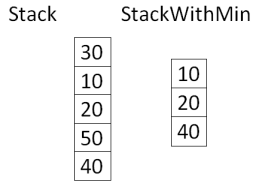
30 10 20 50 40
minimum = 10
pop 30
minimum = 10
pop 10
minimum = 20
pop 20
minimum = 40
pop 50
minimum = 40
pop 40
empty min stack!
minimum = -1
#include <stdio.h>
#include <stdlib.h>

struct node
{
	int data;
	node *next;
};
typedef struct node node_t;

node_t *head = NULL;

void push(int n)
{
	node_t *newNode = (node_t *)malloc(sizeof(node_t));
	newNode->data = n;
	newNode->next = NULL;

	if(head == NULL) {
		head = newNode;
		return;
	}

	node_t *cur = head;
	while(cur) {
		if(cur->next==NULL) {
			cur->next = newNode;
			return;
		}
		cur = cur->next;
	}
}

void pop()
{
	if(head==NULL) return;
	node_t *tmp = head;
	head = head->next;
	free(tmp);
}

void display()
{
	node_t *cur = head;
	while(cur) {
		printf("%3d",cur->data);
		cur = cur->next;
	}
	printf("\n");
}

int main()
{
	push(1);push(2);push(3);push(4);push(5);display();
	pop();display();
	pop();display();
	pop();display();
	pop();display();
	pop();display();
	return 0;
}
Output is:
  1  2  3  4  5
  2  3  4  5
  3  4  5
  4  5
  5
First one becomes head, so when it pops, head will be popped.
#include <iostream>
using namespace std;

class Queue
{
public:
	Queue();
	~Queue();
	void push(int);
	int pop();
	void print();
private:
	typedef struct Node {
		Node *next;
		int data;
	} NODE;
	NODE* head;
};

Queue::Queue()
{
	head = NULL;
}

Queue::~Queue()
{
	if(head == NULL) return;
	NODE *cur = head;
	while(cur) {
		Node *ptr = cur;
		cur = cur->next;
		delete ptr;
	}
}

void Queue::push(int n)
{
	if(head == NULL) {
		head = new NODE;
		head->data = n;
		head->next = NULL;
		return;
	}
	NODE *cur = head;
	while(cur) {
		if(cur->next == NULL) {
			NODE *ptr = new NODE;
			ptr->data = n;
			ptr->next = NULL;
			cur->next = ptr;
			return;
		}
		cur = cur->next;
	}
}

void Queue::print()
{
	if(head==NULL) return;
	Node *cur = head;
	while(cur) {
		cout << cur->data << " ";
		cur = cur->next;
	}
	cout << endl;
}

int Queue::pop()
{
	if(head == NULL) {
		cout << "empty estack!" << endl;
		return NULL;
	}
	NODE *tmp = head;
	int value = head->data;
	if(head->next) {
		head = head->next;
	}
	// pop the last element (head)
	else {
		delete tmp;
		head = NULL;
	}
	cout << "pop: " << value << endl;;
	return value;
}

int main()
{
	Queue *que = new Queue();
	que->push(10);
	que->push(20);
	que->push(30);
	que->push(40);
	que->push(50);
	que->print();
	que->pop();que->print();
	que->pop();que->print();
	que->pop();que->print();
	que->pop();que->print();
	que->pop();que->print();
	que->pop();que->print();
	return 0;
}
Output:
10 20 30 40 50
pop: 10
20 30 40 50
pop: 20
30 40 50
pop: 30
40 50
pop: 40
50
pop: 50
The following code finds intersection/union of two linked list and puts it into a new linked list.
#include <iostream>

using namespace std;

struct node
{
	int data;
	node *next;
};

void add(struct node **head, int n)
{
	struct node *cur;
	struct node *new_node = (struct node *)malloc(sizeof(struct node));
	new_node->data = n;
	new_node->next = NULL;
	if(*head == NULL) {
		*head = new_node;
		return;
	}

	cur = *head;
	while(cur) {
		if(cur->next == NULL) {
			cur->next = new_node;
			return;
		}
		cur = cur->next;
	}
}

bool isDuplicate(struct node *head, int n)
{
	struct node* cur = head;
	while(cur) {
		if(cur->data == n) return true;
		cur = cur->next;
	}
	return false;

}

struct node *getIntersection(struct node *headA, struct node *headB)
{
	struct node *curA = headA;
	struct node *curB = headB;
	struct node *result = NULL;
	if(curA == NULL || curB == NULL) return NULL;
	while(curA) {
		while(curB) {
			if(curA->data == curB->data) {
				add(&result;, curA->data);
			}
			curB = curB->next;
		}
		curB = headB;
		curA = curA->next;
	}
	return result;
}

struct node *getUnion(struct node *headA, struct node *headB)
{
	struct node *cur;
	struct node *result = NULL;
	if(headA == NULL && headB == NULL) return NULL;

	cur = headA;
	while(cur) {
		add(&result;, cur->data);
		cur = cur->next;
	}

	cur = headB;
	while(cur) {
		/* check if the new data is already there */
		if(!isDuplicate(result, cur->data)) {
			add(&result;, cur->data);
		}
		cur = cur->next;
	}
	return result;
}

void display(struct node *head)
{
	if(head == NULL) return;
	struct node *cur = head;
	while(cur) {
		cout << cur->data << ' ';
		cur = cur->next;
	}
	cout << endl;
}

int main()
{
	struct node *myListA = NULL;
	struct node *myListB = NULL;
	struct node *intersectionList = NULL;
	struct node *unionList = NULL;

	add(&myListA;,10);
	add(&myListA;,20);
	add(&myListA;,30);
	add(&myListA;,40);
	add(&myListA;,50);
	add(&myListA;,60);
	add(&myListA;,70);
	cout << "List A: ";
	display(myListA);

	add(&myListB;,10);
	add(&myListB;,30);
	add(&myListB;,50);
	add(&myListB;,70);
	add(&myListB;,90);
	add(&myListB;,110);
	add(&myListB;,130);
	cout << "List B: ";
	display(myListB);

	cout << "Intersection of A and B: ";
	intersectionList = getIntersection(myListA, myListB);
	display(intersectionList);

	cout << "Union of A and B: ";
	unionList = getUnion(myListA, myListB);
	display(unionList);

	return 0;
}
Output is:
List A: 10 20 30 40 50 60 70
List B: 10 30 50 70 90 110 130
Intersection of A and B: 10 30 50 70
Union of A and B: 10 20 30 40 50 60 70 90 110 130
The following example is another example of generic use of linked list. It will be used as a base for doubly linked list later.
#include <iostream>

using namespace std;

template <typename T>
class List
{
	struct Node
	{
		T data;
		Node *next;
		Node(T d, Node *n = 0):data(d), next(n) {}
	};
	Node *head;

public:
	List(Node *h = 0):head(h){}
	~List();
	void insert(Node *loc, T d);
	void push_back(T d);
	void push_front(T d);
	T pop_back();
	T pop_front();
	void erase(Node *loc);
	void display();
	Node *search(T d);
};

// destructor
template <typename T>
List<T>::~List()
{
	Node *tmp;
	while(head) {
		tmp = head;
		head = head->next;
		delete tmp;
	}
}

// insert d before loc
template <typename T>
void List<T>::insert(Node *loc, T d)
{
	Node *new_node = new Node(d,0);
	if(!head) {
		head = new_node;
		return;
	}
	if(loc == head) {
		push_front(d);
		return;
	}
	Node *cur = head;
	while(cur->next) {
		if(cur->next == loc) {
			new_node->next = cur->next;
			cur->next = new_node;
			return ;
		}
		cur = cur->next;
	}
}

template <typename T>
void List<T>::push_back(T d)
{
	Node *new_node = new Node(d,0);
	if(!head) {
		head = new_node;
		return;
	}
	Node *cur = head;
	while(cur) {
		if(!cur->next) {
			cur->next = new_node;
			return;
		}
		cur = cur->next;
	}
}

template <typename T>
void List<T>::push_front(T d)
{
	Node *new_node = new Node(d,0);
	if(!head) {
		head = new_node;
		return;
	}
	new_node->next = head;
	head = new_node;
	return;
}

template <typename T>
T List<T>::pop_back()
{
	Node *cur = head;
	while(cur) {
		if(!cur->next) {
			T data (cur->data);
			delete cur;
			head = NULL;
			return data;
		}
		else {
			if(!cur->next->next)  {
				T data (cur->next->data);
				cur->next = NULL;
				delete cur->next;
				return data;
			}
		}
		cur = cur->next;
	}
	return NULL;
}

template <typename T>
T List<T>::pop_front()
{
	if(!head) return NULL;
	Node *tmp = head;
	T data (head->data);
	if(head->next) {
		head = head->next;
		delete tmp;
		return data;
	}
	delete tmp;
	head = NULL;
	return data;
}

template <typename T>
void List<T>::erase(Node *loc)
{
	if(loc == head) {
		Node *tmp = head;
		head = head->next;
		delete tmp;
		return;
	}
	Node *cur = head;
	while(cur) {
		if(cur->next == loc) {
			cur->next = loc->next;
			delete loc;
		}
		cur = cur->next;
	}
}

template <typename T>
typename List<T>::Node* List<T>::search(T d)
{
	if(!head) return NULL;
	Node* cur = head;
	while(cur) {
		if(cur->data == d) return cur;
		cur = cur->next;
	}
	return NULL;
}

template <typename T>
void List<T>::display()
{
	if(!head) return;
	Node *cur  = head;
	while(cur) {
		cout << cur->data << " " << endl;
		cur = cur->next;
	}
	cout << endl;
}

int main()
{
	List<int> *myList = new List<int>(NULL);

	cout << "push_back() 20, 30 40, 50\n\n";
	myList->push_back(20);
	myList->push_back(30);
	myList->push_back(40);
	myList->push_back(50);
	myList->display();

	cout << "push_front() 10\n\n";
	myList->push_front(10);
	myList->display();

	cout << "erase 30\n\n";
	myList->erase(myList->search(30));
	myList->display();

	cout << "insert 30 before 40\n\n";
	myList->insert(myList->search(40),30);
	myList->display();

	cout << "pop_back()\n";
	cout << myList->pop_back() << " just back popped\n\n";
	myList->display();

	cout << "pop_front()\n";
	cout << myList->pop_front() << " just front popped\n\n";
	myList->display();

	return 0;
}
Output:
push_back() 20, 30 40, 50

20
30
40
50

push_front() 10

10
20
30
40
50

erase 30

10
20
40
50

insert 30 before 40

10
20
30
40
50

pop_back()
50 just back popped

10
20
30
40

pop_front()
10 just front popped

20
30
40
- Example 1
When the head of the list is not a global pointer. - Example 2 and Example 3
When the head of the list is a global pointer.
There are some implementation differences between these two examples. - Example 4
Used class & structure in that class. - Example 5A
Detecting circular (loop) linked list. - Example 5B
Detecting circular (loop) linked list (Generic Class with Template). - Example 6
Stack with linked list data structure. - Example 7
Class Stack with linked list data structure. - Example 7B
Class Stack with linked list data structure. - Example 7C
Class Stack using linked list with query for minimum value. - Example 7D
Stack Class Using Linked List with Query for Minimum Value (additional stack). - Example 8
Queue Struct with linked list data structure. - Example 8B
Queue Class with linked list data structure. - Example 9
Finding intersection and union of two linked lists. - Example 10
Generic linked lists.
Also, there are set of linked list samples:
Bogotobogo Image / Video Processing
Computer Vision & Machine Learning
with OpenCV, MATLAB, FFmpeg, and scikit-learn.


Bogotobogo's Video Streaming Technology
with FFmpeg, HLS, MPEG-DASH, H.265 (HEVC)


Bogotobogo's contents
To see more items, click left or right arrow.


Ph.D. / Golden Gate Ave, San Francisco / Seoul National Univ / Carnegie Mellon / UC Berkeley / DevOps / Deep Learning / Visualization
 My YouTube channel